What can four organisations from North East England tell us about impact?
Most community organisations aren't short of data. They're short of data they can use.
Time spent collecting information nobody looks at is time taken away from young people, patients and communities.
We've worked alongside charities and community groups in Newcastle and across the North East of England for more than a decade. The organisations that get the most from their evidence aren't the ones collecting the most. They're the ones that decided early what they needed to understand, and built their recording around that.
A neighbourhood youth project, a multi-service charity, a specialist health organisation and a detached youth project all need different things from their data. Here's what each of them did, what changed, and what you can take from it.

1. Is recording part of everyday delivery, or a scramble before every report?
Northbourne Street Initiative runs many different programmes of provision for children and young people, including girls' groups, community activities and the Duke of Edinburgh's Award. We've worked with them since 2018.
The challenge wasn't a lack of evidence. It was that recording sat with a few people, and pulling it together for funders took time away from delivery. Together we agreed a small set of things every session should capture, and built simple, consistent recording into the Upshot system so the whole team could do it as part of their normal week.
“It’s been a great way to get staff more involved in the recording and reporting elements of the work which they do...The support offered by Upshot to enable us to do this has been greatly appreciated.”
Rachel Craig, Youth Initiative Manager
The lesson
Make recording part of delivery and you build your evidence as you go. When a funder asks, it's already there, and your team has been learning from it all along.
2. Do you have different services but still need a shared picture?
YMCA Newcastle spans family and youth work, health and wellbeing, advice, supported housing, training and education. It has used the Upshot system since 2013, which makes it one of our longest-standing partners.
That's a lot of very different work, from outreach to a job club. Each project tells its own story and shouldn't be forced into the same measures. But leadership still needs to see what's happening across all of it.
We worked with YMCA Newcastle to agree which measures every service shares and which stay specific to each project. That lets individual programmes keep what matters to their work while the organisation sees the bigger picture.
The lesson
You don't have to choose between consistency and flexibility. Decide what every service has in common, and let the rest follow the work.
3. Does your evidence reflect how people actually engage?
Blue Sky Trust supports people living with HIV and trains professionals to provide safe, inclusive and stigma-free services.
People connect with Blue Sky Trust in very different ways. Someone receiving one-to-one advocacy has a very different relationship with the charity from someone who comes to a peer support group, volunteers, or attends a training session as a professional. Count them all as "people supported" and you get one big number that tells you very little. Was that one person over many months, or a room of professionals for an afternoon?
So when Blue Sky Trust started with Upshot in March 2025, the first conversation wasn't about the system. It was about what counts as engagement in each part of their work. We then set things up around four areas: the HIV Community Programme, the Volunteer Project, Community Outreach, and Workforce, Organisation and System Development.
Because much of this information is sensitive, we also agreed what needed to be recorded at all, who could see it, and how it would be stored securely in line with GDPR.
The lesson
Let your evidence follow how people actually use your services. One headline number is easy to report, but it rarely tells you anything you can act on.


4. Several funders, several sets of requirements: who is your measurement for?
Phoenix Detached Youth Project has supported young people aged 13 to 25 in Meadow Well, Percy Main, East Howdon, Royal Quays and Chirton since 2004. Its work ranges from Helping Hands groups to drop-ins, and it has been using the Upshot system since 2024.
Like many community organisations, Phoenix Detached Youth Project has several funders, each with its own reporting requirements. The easy route is to build your monitoring around whatever each funder asks for. The result is usually a pile of data that serves the reports but not the work.
We started from the other end: what does the organisation need to understand about its own work? Funder requirements were then mapped onto that core, rather than driving it.
The lesson
Measurement should fit the reality of delivery, not be led by funding requirements. Ask why you're collecting each piece of information. If it isn't useful enough to justify the time it takes, stop collecting it.
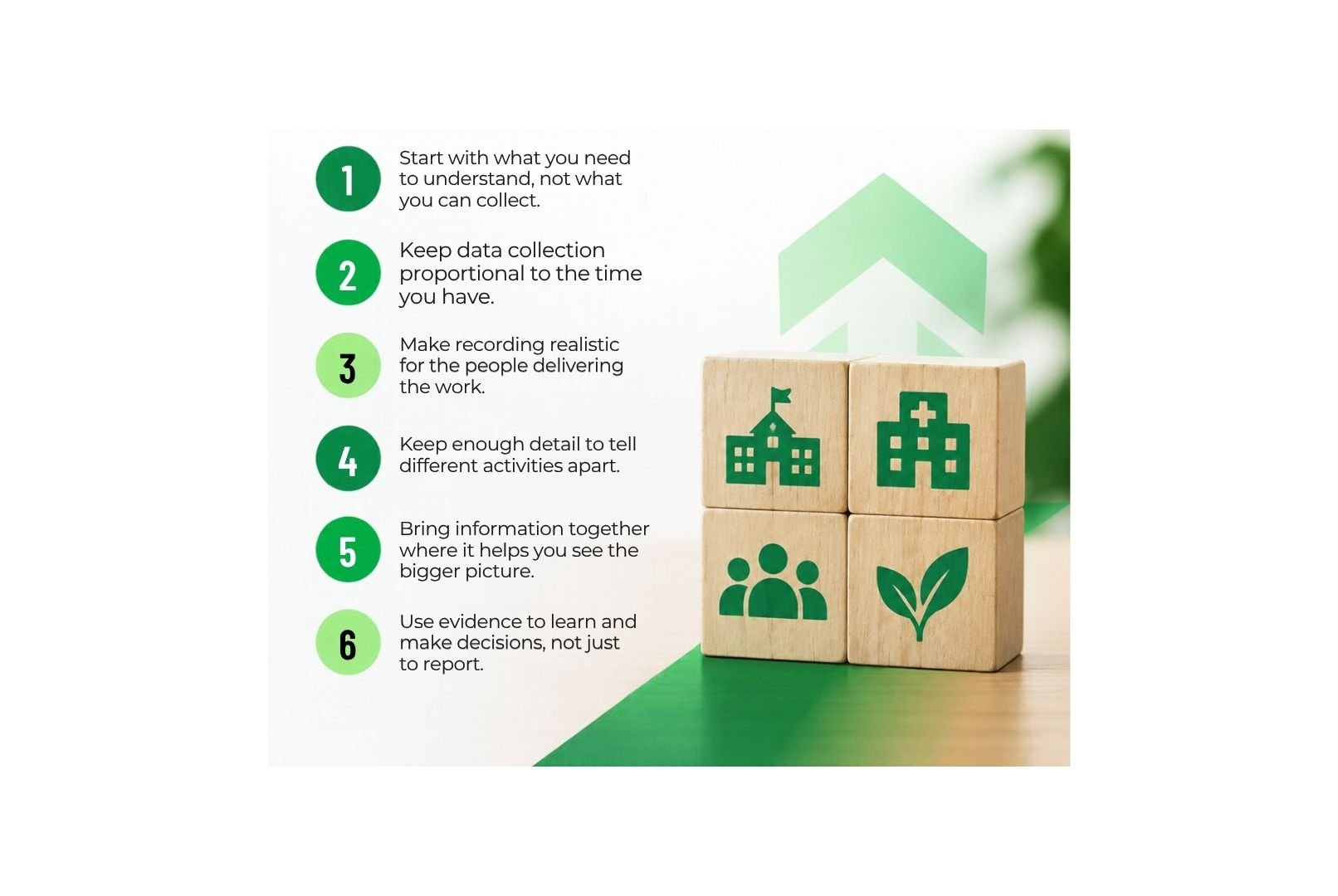
Four organisations, six principles
Give all four of these organisations the same monitoring approach and you'd miss the point. But the same principles held for every one of them:
1. Start with what you need to understand, not what you can collect.
2. Keep data collection proportionate to the time you have.
3. Make recording realistic for the people delivering the work.
4. Keep enough detail to tell different activities apart.
5. Bring information together where it helps you see the bigger picture.
6. Use evidence to learn and make decisions, not just to report.
Better measurement isn't about collecting more data. It's about collecting the right information, and being able to use it.
For funders and local authorities: one view without one-size-fits-all
The same tension plays out at a bigger scale. Funders, local authorities and organisations running programmes through several delivery partners need to understand what's happening across their investment. Their delivery partners need monitoring that stays relevant and manageable for them.
Those needs don't have to compete. With the Upshot system, each delivery organisation can have its own account, linked to a wider funder or programme account. Partners manage the information that matters to their own work. The funder sees the picture across the whole programme.
For place-based initiatives involving many community organisations, this matters most. More consistency shouldn't mean expecting every organisation to work, deliver or measure in exactly the same way.
Where to start?
Upshot combines an impact platform used by more than 1,800 charities, funders and social impact-led organisations with hands-on monitoring, evaluation and learning (MEL) support from a team that has worked in the sector for nearly 15 years.
We work with organisations wherever their practice is today. That might mean improving an existing approach, bringing several programmes together, building a new measurement framework, or setting up a structure across multiple delivery partners.
Whatever the situation, we start with the same question: what do you need to understand, and what evidence will help you make better decisions?
What do you need to understand, and what evidence will help you make better decisions?